
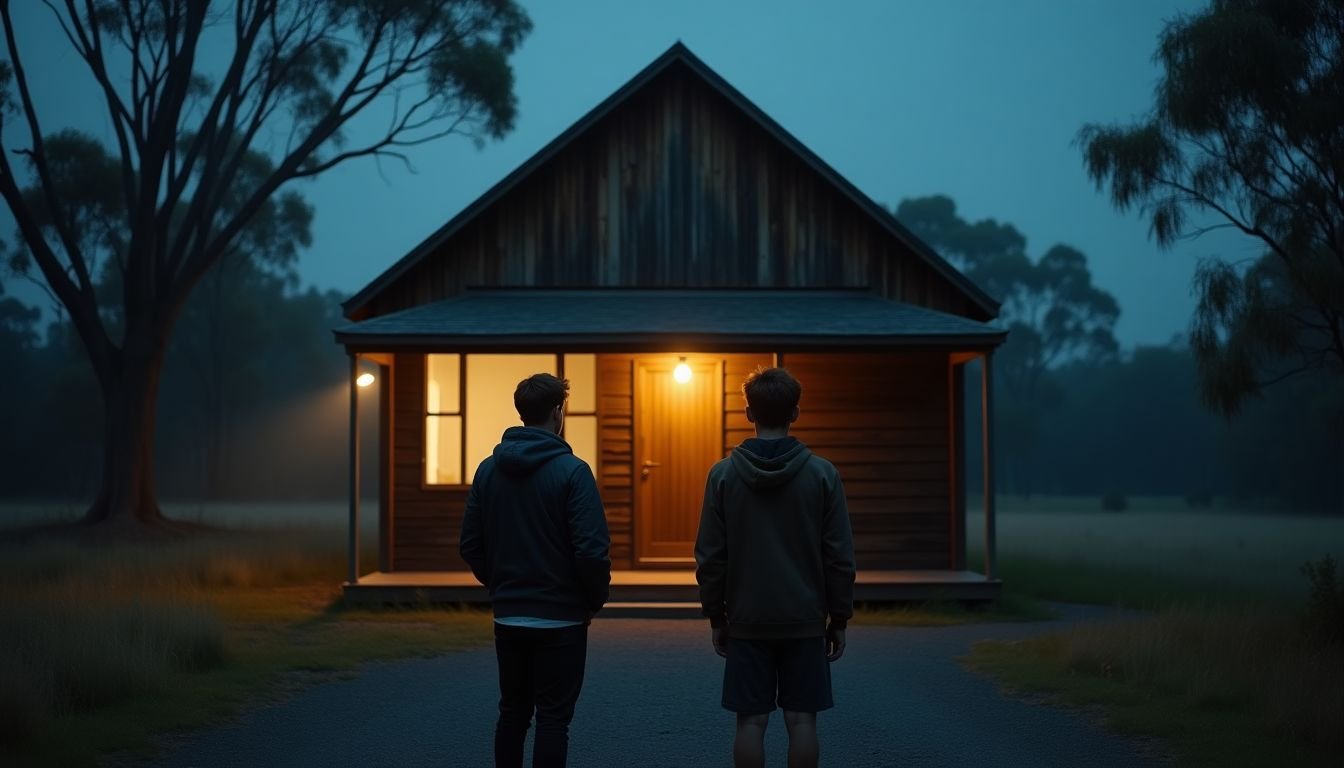
The Australian film Leviticus is the first feature from writer-director Adrian Chiarella, and it frames a familiar social issue inside a genre setup built to unsettle. At the centre are two teenage boys, Naim and Ryan, whose attraction to one another becomes the focal point of a relentless, otherworldly menace that assumes the face of what each boy longs for most. The movie deliberately blends intimate coming-of-age material with the mechanics of psychological horror, so that private feelings—shame, longing, fear—are externalised into a literal, stalking presence.
Set against the backdrop of a conservative Christian community in regional Australia, the film anchors its supernatural elements to a very specific cultural discourse by borrowing its name from a biblical chapter often invoked in homophobic arguments. The title serves as more than provocation: it is the thematic fulcrum that ties the film’s social commentary to its spooky conceit. Chiarella stages the story as both an exploration of the harm inflicted by coercive religious interventions and a visceral thriller that asks what happens when desire becomes a target.
Premise and narrative approach
From inward conflict to outward terror
Leviticus follows Naim and Ryan as their secret intimacy attracts a supernatural force that takes a disturbing, voyeuristic form—appearing to each boy as the person they most desire, which in practice means each other. This choice converts internalised homophobia and the trauma of conversion attempts into on-screen menace. The film treats conversion therapy as an active, corrosive force rather than a static background detail, and its horror device is designed to make viewers feel how repression and community pressure can metabolise into violence. The fusion of romantic yearning with dread creates stakes that are both emotional and life-or-death.
Cast, crew and creative team
Performances and production notes
The two young leads carry the film’s emotional weight, supported by an ensemble that adds texture and tension. Joe Bird and Stacy Clausen play the teenagers at the heart of the story, while established actor Mia Wasikowska appears as the emotionally distant mother of one of the boys. Other notable cast members include Jeremy Blewitt, Ewen Leslie and Davida McKenzie. A Causeway Films and Salmira Productions produced the picture with producers Samantha Jennings, Kristina Ceyton and Hannah Ngo among the credited team. The film’s production design and cinematography emphasise a small-town atmosphere—claustrophobic, insular and watchful—so that environment itself feels like a character contributing to the boys’ isolation.
Festival reaction and distribution
Sundance premiere and Neon acquisition
Leviticus premiered in the Midnight section of the Sundance Film Festival, where it captured attention as a standout entry in the emerging slate of queer genre cinema. The film was acquired by distributor Neon in a significant deal reported to be in the seven-figure range, a signal that the company expects the film to resonate beyond niche audiences. Early critical responses have been favourable: reviewers highlighted the movie’s capacity to balance a supernatural premise with grounded performances and meaningful themes, suggesting it may take a secure place among contemporary queer horror films.
Why the film matters
Genre, politics and cultural conversation
Beyond its jump scares and visual design, Leviticus operates as a conversation starter about the ongoing harms of conversion therapy and the ways religious doctrine can be weaponised against queer people. By literalising repression as a predatory presence, the film asks viewers to consider the real-world consequences for those living in communities where sexual identity is condemned. Its June 19 theatrical release gives audiences a chance to experience that argument with full sensory force, and the combination of horror mechanics and social critique is likely to prompt discussion across film circles and LGBTQ+ communities.
Final note
For viewers drawn to films that use genre to interrogate social issues, Leviticus presents an intense, conversation-driving experience: a debut that marries the intimacy of first love and fear with a relentless supernatural hook, anchored by striking performances and clear thematic intent.


