For a long time, Djehan, a 24-year-old woman, believed she had to choose between being Réunionnaise and being queer. She could stay rooted in the culture she grew up with, or move to mainland France to complete her gender transition. On a Saturday morning at the LGBT+ centre in Saint-Denis, she listens as Jocelyne, a 65-year-old retiree, sings a maloya standard, the traditional music of La Réunion, with a rewritten chorus: “I no longer sleep in my man’s house.”
A community centre run by Pilon
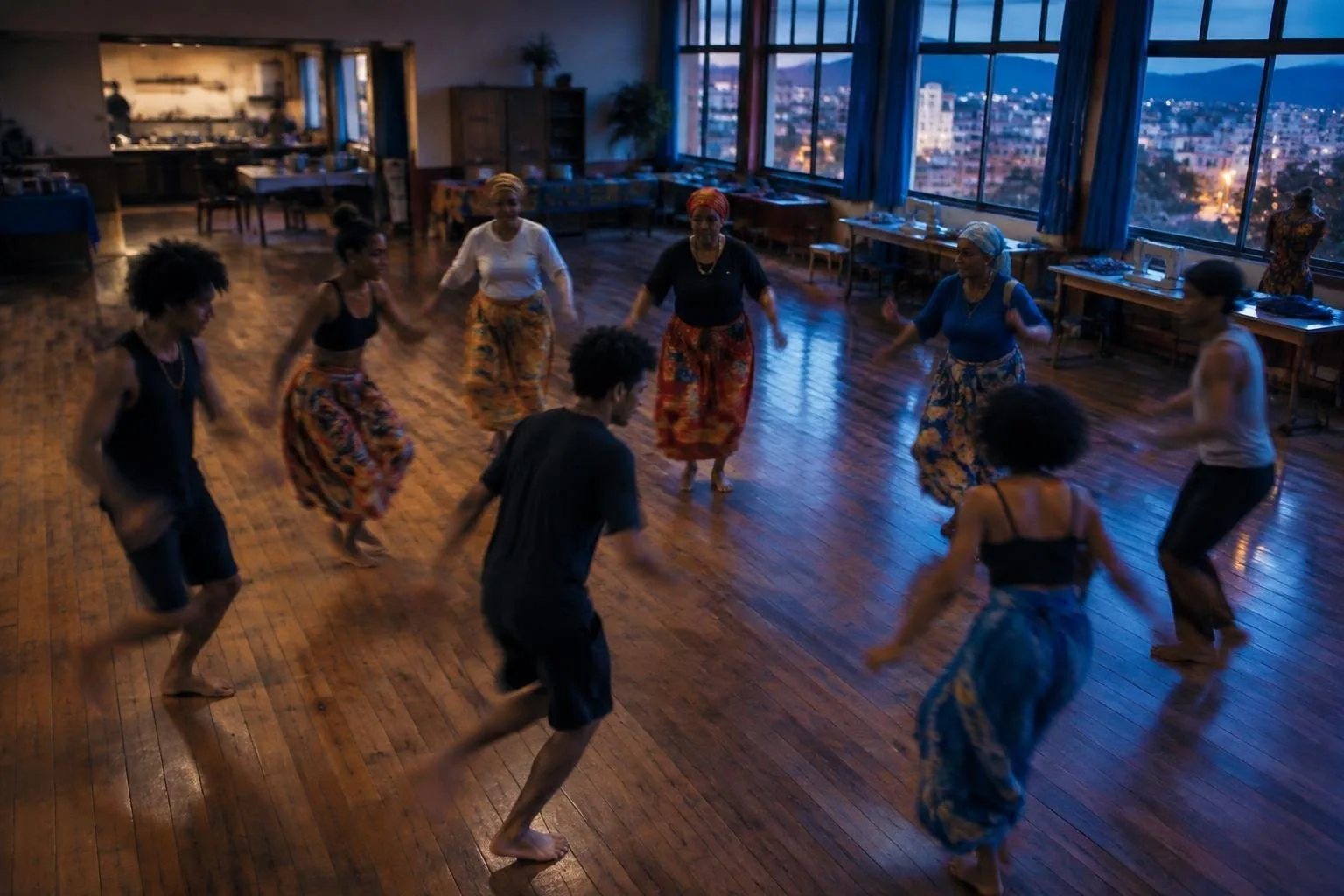
The association Pilon has managed the centre since the start of the year. The building was made available by the mairie de Saint-Denis, and Pilon co-runs it with three other LGBT+ organisations: Requeer, Kwir Mouvman and Timizé. Its goal is to give queer lives a visible place in Réunionnais culture, and the workshops are where that happens. On cooking, sewing and maloya days, young people from the association work alongside older members, passing on skills and stories in both directions.
On the day of a monthly traditional cooking workshop, about twenty people were busy in the courtyard. The menu was gratin créole. Inside, a woman known respectfully as “Madame Berthe” supervised the peeling of green papayas and potatoes, while Jocelyne fetched the cheese. A third member of the group, Marie-Andrée, watched sweet potatoes cooking with onion, ginger and thyme. Pilon calls the three women its “club des mamies,” or grandmothers’ club.
The group began in 2025, when the three women met Terry Grimoire, the founder of Pilon, at a neighbourhood social centre. He was looking urgently for volunteers who could sew the last dresses for a parade before 20-Décembre, the day La Réunion commemorates the abolition of slavery. “I had time, I said yes, and I never left,” Jocelyne recalls. Months earlier, with help from the young people at Pilon, she had also left an abusive relationship. The group that formed around these tasks has become what its members describe as a chosen family.
Visibility on an island where tradition runs deep
On this island in the Indian Ocean, religion and tradition hold a central place, and many young queer people face rejection from their families. A parliamentary report published in 2018 on anti-LGBT discrimination in the Outre-mer described a taboo around homosexuality as “revealing of a form of cultural homophobia that feeds a demanding form of censorship or self-censorship.” In a sexology thesis presented in 2024 at the université du Québec, researcher Madeleine Bègue found that “the refusal of homosexuality shows up in the pressure not to show one’s identity.”
Public spaces of visibility therefore matter more here than elsewhere. They include the Pride de Saint-Denis, launched in 2021, and an exhibition by photographers Raya Martigny and Édouard Richard about queer youth in La Réunion. Terry Grimoire describes the family situation many of these young people face: “Some are thrown out, others are constantly questioned or even insulted by their families. So they withdraw from festive family gatherings or cut themselves off from traditions. Our aim is to recreate that family atmosphere that is specific to La Réunion.”
The association’s name carries the same intent. A pilon is the pestle traditionally given to couples setting up a home. In Mauritian and Seychellois Creole, however, the word is also a homophobic insult. By reclaiming it, Pilon shows that people can build family in new ways without giving up their traditions.
Grandmothers and young people learning from each other
The presence of three retired, practising believers in an LGBT+ centre was not an obvious fit. Berthe admits as much: “At first I did not really understand what this centre was or what they did here. But now I understand, and I think it is very good.” Terry Grimoire sees the meeting of two worlds as meaningful. “At some point in their lives, they may have seen being transgender or being gay as a bad thing. But today they focus on spreading love.” In May, at a diversity award ceremony that Pilon had been invited to attend, Jocelyne spoke publicly: “LGBT+ children should not be rejected. They are born this way, and it is a blessing.”
The centre has also changed the lives of the women themselves. “I used to be very lonely, I did not leave my house,” Berthe says. “Now I come almost every day, and I feel at ease here. The other grandmothers and I help each other.” Jocelyne describes the change in similar terms, saying the young people supported her and helped her move house. “Without them, I would not be here.”
For Djehan, the workshops offer something she had been missing. “Listening to maloya that speaks about our realities soothes my heart,” she says. “It makes our lives exist here, in La Réunion.” Pilon now plans training in digital skills and in welcoming and guiding LGBT+ people, and the three women have become full members of the association. Djehan no longer feels she has to pick one identity over the other.